

Semax vs Selank: Two Russian Heptapeptides With the Same Tail, Different Parents, and Very Different Amounts of Accessible Evidence
Semax and Selank get discussed together constantly, usually as two flavours of the same Russian nootropic idea. They are more closely related than most comparisons manage to explain, and less similar than the pairing implies. Both are seven residues. Both end in the same three-residue tail, added for the same reason. What sits in front of that tail comes from two completely different parent molecules, and that is where the comparison actually lives.
Research-use-only disclaimer: Semax and Selank supplied as research chemicals are intended strictly for in-vitro and laboratory research use and are not intended for human or veterinary use in that context. Approval in other jurisdictions is described because it is a real difference between these compounds and other research peptides, and it refers to separate pharmaceutical products. No dosing or administration guidance appears in this article, and nothing here is medical advice.

TL;DR
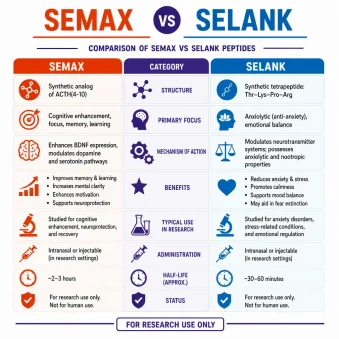
Semax is MEHFPGP, an ACTH fragment with a Pro-Gly-Pro tail. Selank is TKPRPGP, the immune peptide tuftsin with the same tail. That shared Pro-Gly-Pro is a deliberate design choice for protease resistance, and it has been reported to carry activity of its own. Semax research centres on BDNF and neurotrophic signalling, with a single rodent administration producing about a 1.4-fold rise in BDNF protein and a 3-fold rise in BDNF mRNA. Selank research centres on anxiolytic effects without sedation. Both are approved in Russia and neither by the FDA. On 24 July 2026 PCAC voted 8 to 5 to recommend Semax for the 503A list; Selank was not reviewed. Research use only.
Semax: Met-Glu-His-Phe-Pro-Gly-Pro. Parent molecule ACTH. Neurotrophic research.
Selank: Thr-Lys-Pro-Arg-Pro-Gly-Pro. Parent molecule tuftsin. Anxiolytic research.
Shared: the Pro-Gly-Pro C-terminal tail, added for protease resistance.
Semax BDNF data: ~1.4-fold protein, ~3-fold mRNA, single rodent administration.
Both approved in Russia. Neither approved by FDA or EMA.
PCAC July 2026: Semax recommended 8 to 5. Selank not reviewed.
Storage: Semax has methionine and an oxidation route. Selank does not.
The Sequences, Side by Side
Start here, because almost every comparison of these two skips the structures and goes straight to described effects, which makes the relationship impossible to see.
| Bioactive core | Tail | Parent molecule | |
|---|---|---|---|
| Semax | Met-Glu-His-Phe | Pro-Gly-Pro | ACTH fragment |
| Selank | Thr-Lys-Pro-Arg | Pro-Gly-Pro | Tuftsin |
Semax is Met-Glu-His-Phe-Pro-Gly-Pro, written MEHFPGP.[1] The first four residues correspond to a fragment of adrenocorticotropic hormone.
Selank is Thr-Lys-Pro-Arg-Pro-Gly-Pro. The first four residues, TKPR, are tuftsin, a tetrapeptide that comes from the heavy chain of immunoglobulin G.
So the comparison is not between two versions of one idea. It is between an ACTH derivative and an immunoglobulin derivative that happen to have been finished the same way.
The Pro-Gly-Pro Tail, and Why Both Have One
This is the part I find genuinely interesting, and it took me a while to notice that it was the same three residues on both.
Short peptides are cleared fast. Aminopeptidases and carboxypeptidases chew inward from both ends, and a four-residue fragment in circulation has a very short life. Any attempt to turn a short bioactive fragment into something usable has to solve that problem first.
The solution used on both of these is a Pro-Gly-Pro extension on the C-terminus.[1] Proline is unusual among amino acids because its side chain loops back to the backbone nitrogen, which constrains the local geometry and makes proline-containing bonds poor substrates for many peptidases. Sticking prolines at the exposed end obstructs the enzymes that would otherwise start there.
The same modification appears on both compounds because both came out of the same Russian design programme, and it is a recognisable signature of that work rather than a coincidence.
There is a wrinkle that makes it more than a stabilising trick. Pro-Gly-Pro has been reported to carry pharmacological activity of its own, independent of whatever it is attached to.[1] That complicates interpretation of any result from either compound. If the tail is not inert, then a study of Semax is a study of an ACTH fragment plus PGP, and part of what you measure could belong to the tail.
Semax, and the BDNF Numbers
Semax research centres on neurotrophic signalling, and specifically on brain-derived neurotrophic factor.
The figure that gets quoted comes from rodent work: a single administration produced roughly a 1.4-fold increase in BDNF protein and a 3-fold increase in BDNF mRNA.[1]
Those two numbers are worth reading against each other rather than separately, and almost nobody does. Transcription more than tripled while protein went up by 40 percent. That gap says the response is limited somewhere downstream of transcription, at translation or at protein turnover, and it means quoting the mRNA figure alone would overstate what happened by roughly a factor of two.
I would treat the protein number as the meaningful one and the mRNA number as a mechanistic observation about where the compound acts. A source that leads with "3-fold increase in BDNF" without saying which measurement is doing something misleading.
Semax has also been reported to affect NGF and other neurotrophins, and the applied research in Russia has concentrated on acute neurological injury, particularly stroke, and on optic nerve conditions.[1]
PrymaLab supplies Semax as 5mg and 11mg reference material, and in nasal spray and autoinjector formats.
Selank, and Its Unlikely Parent
Selank is an anxiolytic in its research profile, described as reducing anxiety-like behaviour without the sedation that characterises benzodiazepines.[1]
The odd part is where it comes from. Tuftsin is an immunological peptide, cleaved from the Fc region of immunoglobulin G, and its known activity is stimulating phagocytosis in macrophages and neutrophils. An anxiolytic derived from an antibody fragment is not an obvious design path.
Reported mechanisms include effects on GABAergic and serotonergic signalling and on the enzymes that degrade endogenous enkephalins, plus effects on BDNF expression that overlap with Semax territory. I am going to be straight that I find the mechanistic picture for Selank considerably muddier than for Semax, and I do not think that is only my reading. A compound that touches GABA, serotonin, enkephalin metabolism and neurotrophins is either genuinely pleiotropic or has been studied by measuring many things and reporting whatever moved.
PrymaLab supplies Selank as 5mg and 11mg reference material, and in nasal spray and autoinjector formats.
The Tuftsin Question
Selank's parent deserves more than the sentence it usually gets, because the lineage raises a question about the compound that I have not seen addressed.
Tuftsin is Thr-Lys-Pro-Arg, four residues cleaved from the Fc region of immunoglobulin G heavy chain. It was characterised as an immunostimulant: it binds receptors on macrophages and neutrophils and promotes phagocytosis. That is its documented biology and it has nothing obvious to do with anxiety.
So Selank is an immunomodulatory tetrapeptide with a stabilising tail attached, studied and approved for anxiolytic effects. Either the anxiolytic activity emerges from the modification, or tuftsin itself has central actions that its immunological characterisation missed, or the two effects are connected through something like neuroimmune signalling.
The third possibility is the interesting one and it is not far-fetched. Immune signalling and mood regulation are connected through well-documented routes, and cytokines influence behaviour. A peptide acting on macrophage receptors having downstream behavioural effects is not absurd.
What I cannot tell you is which of those explanations the Russian literature supports, or whether it addresses the question at all. This is the clearest example of the access problem described in the next section: the question is obvious, the answer probably exists somewhere, and I cannot get to it.
It also means that when a supplier page describes Selank's mechanism as GABAergic or serotonergic, that description may be downstream of something else entirely, and it is presented with more confidence than the lineage justifies.
The Evidence Problem Nobody States
Every page comparing these two mentions that both are approved in Russia, usually as a credential. It is a real fact and it deserves more scrutiny than it gets.
Approval means a regulator reviewed a dossier and permitted marketing. For a Western researcher trying to evaluate these compounds, the useful question is whether that dossier can be examined, and largely it cannot. The supporting trial literature is predominantly Russian-language, much of it published in journals that are not indexed in the databases most people search, and a good deal of it predates the era when trial registration and data sharing became normal expectations.
That is not an accusation that the work is bad. It is a statement that it is hard to check, and those are different things which get conflated in both directions. Sceptics treat inaccessibility as evidence of weakness. Advocates treat approval as though it carried the same information as an FDA approval whose review documents are downloadable. Neither is right.
What it means practically: for Semax and Selank you are relying on secondary summaries more heavily than for a compound whose primary literature you can read. I would weight claims about these two accordingly, and I would be especially cautious about specific numerical claims that circulate without a traceable source.
The Amidate Variants, and What They Change
Search around either compound for long enough and you will hit N-Acetyl Semax Amidate and N-Acetyl Selank Amidate, usually abbreviated NASA and NA-Selank. They are worth understanding because the modification follows the same logic as the PGP tail and applies it to the other end of the molecule.
Two changes are made. N-terminal acetylation caps the free amino group at the front of the peptide with an acetyl group. C-terminal amidation converts the terminal carboxylic acid to an amide.
Both changes attack the same problem the PGP tail attacks, from different directions. Aminopeptidases require a free N-terminal amino group to grip, and acetylation removes it. Carboxypeptidases require a free C-terminal carboxyl, and amidation removes that. The base peptide already has proline residues obstructing the C-terminus; the amidate versions add chemical protection on top of geometric protection.
There is a second effect that gets less attention. Amidation removes a negative charge from the C-terminus, which changes the molecule's overall charge distribution. For a compound intended to cross mucosal membranes, charge is one of the properties that determines whether it gets anywhere, so the modification is not purely about protease resistance.
What I have not been able to establish is whether the amidate versions have their own body of published research or whether the evidence is assumed to transfer from the parent compounds. My impression is that most of it transfers by assumption. Acetylation and amidation are conservative modifications, but they are modifications, and a compound with a capped N-terminus is not identical to one without.
PrymaLab does not currently stock either amidate form. If we add them, the honest framing on the product page will be that they are stability-modified analogues of compounds with Russian clinical history, rather than compounds with clinical history of their own.
Both Are Usually Studied Intranasally
One practical thing these two share beyond the tail: the Russian clinical application of both has been predominantly intranasal, and that is not incidental to how they are discussed.
Semax at 813 Da and Selank at roughly 751 Da are small by peptide standards, which puts them in the size range where paracellular passage through the nasal epithelium is plausible rather than aspirational. That distinguishes them from most of the nasal spray catalogue, where the compounds are considerably larger and the route is more of a hope than a mechanism.
The nose-to-brain question is also more relevant for these two than for a peripherally acting compound, because both are studied for central effects. Olfactory and trigeminal pathways offer a route toward the central nervous system that does not require crossing the blood-brain barrier, and for a compound whose target is in the brain that pathway is the whole argument for the route.
The caveats from the intranasal delivery reference apply in full. The olfactory region is a small fraction of total nasal surface area in humans, ordinary spray devices deposit most of their volume lower down, and the fraction of an applied dose reaching the CNS by that route in humans has been contested for two decades. Being the right size to permeate is necessary and not sufficient.
Where They Sit in 2026
On 23 and 24 July 2026 the Pharmacy Compounding Advisory Committee reviewed seven peptides for the 503A affirmative list. One of these two was included and the other was not.
Semax passed 8 to 5 with one abstention on 24 July.[2] Epitalon passed 7 to 5 the same day. DSIP, submitted as emideltide, was rejected 6 to 7.[2]
Selank was not among the seven reviewed, so it has no PCAC position either way.
Three things follow. The votes are advisory and not binding on the FDA.[2] None of the recommended compounds is legal to compound today, because rulemaking has to run and the HHS Secretary must approve any addition.[2] And an 8 to 5 vote with an abstention is a divided committee deciding narrowly rather than an endorsement.
For laboratory reference material this changes nothing directly, since 503A governs pharmacy compounding rather than research supply. It does mean Semax is now a compound under active regulatory attention and Selank is not, which is a difference between them that did not exist a year ago.
One Has a Storage Problem the Other Does Not
This falls out of the sequences and it is the kind of practical difference that never appears in a nootropic comparison.
Semax has methionine at position 1. Methionine oxidation to methionine sulfoxide is the most common peptide degradation reaction, and a methionine sitting at the exposed N-terminus is about as accessible as it gets. The oxidised product weighs 16 daltons more than the parent and is otherwise intact, so a mass check that is not looking for it can miss it.
Selank contains no methionine, no cysteine and no asparagine. Threonine, lysine, proline, arginine, proline, glycine, proline. Oxidation has no obvious target and deamidation has no obvious target. Two of the four major degradation routes are largely unavailable to it.
Both are proline-rich at the C-terminus, which is the point of the PGP tail, and both are therefore reasonably resistant to enzymatic degradation. Chemical degradation in storage is a separate matter from enzymatic degradation in circulation, and on the chemical side these two are not equivalent.
The practical version: if you are comparing certificates of analysis for these two, ask specifically whether the Semax assay resolves the sulfoxide. For Selank that question matters much less. Fuller treatment of the underlying chemistry is in the peptide storage and stability reference.
Side by Side
| Semax | Selank | |
|---|---|---|
| Sequence | MEHFPGP | TKPRPGP |
| Parent molecule | ACTH fragment | Tuftsin, from IgG heavy chain |
| Shared feature | Pro-Gly-Pro C-terminal tail for protease resistance | |
| Main research area | Neurotrophic signalling, acute neurological injury | Anxiolytic effects without sedation |
| Headline finding | ~1.4x BDNF protein, ~3x BDNF mRNA, single rodent dose | Anxiety-like behaviour reduced without sedation |
| Russian approval | Yes | Yes |
| FDA approval | No | No |
| PCAC July 2026 | Recommended, 8 to 5 | Not reviewed |
| Oxidation-vulnerable residue | Methionine at position 1 | None |
What Research Has Not Established
No published head-to-head comparison places Semax and Selank against each other under matched conditions. Every comparison available, including this one, assembles separate literatures with separate designs and endpoints.
No study I can find runs Pro-Gly-Pro alone as a control arm, which leaves the contribution of the shared tail unresolved for both compounds.
No Western regulatory review has assessed either compound, and the Russian evidence base is difficult to examine independently for the reasons above.
For Selank specifically, the mechanistic picture is reported across GABAergic, serotonergic, enkephalinergic and neurotrophic systems, and I have not seen a convincing account of which of those is primary. That is a real gap and not a rhetorical hedge.
What is reasonably established: the sequences, the design logic behind the PGP tail, the direction and rough magnitude of the Semax BDNF effect in rodents, the Russian approval status of both, and the PCAC outcome. Those are checkable. Most of what surrounds them in this category is not.
If You Were Actually Comparing Them
Most content on these two compounds describes them. Very little of it says what an experiment separating them would look like, which is odd given that both are sold as research material.
Three design problems stand out, and none of them is exotic.
The endpoint problem. Semax and Selank are studied against different outcomes, so a head-to-head needs an endpoint both could plausibly move. BDNF expression is the obvious candidate, since Semax has direct data there and Selank has been reported to affect it too. Anxiety-like behaviour in a rodent model is the other, and it favours Selank by construction. Picking either one loads the result before you start, which may be why nobody has published the comparison.
The control problem. Covered earlier, and it applies to both compounds equally. If Pro-Gly-Pro has activity of its own, then a two-arm study comparing Semax against Selank cannot distinguish core effects from tail effects, because both arms contain the tail. A useful design needs four arms: Semax, Selank, PGP alone, and vehicle. I have not found that done and it is the first thing I would fund.
The route problem. Both have Russian clinical histories built on intranasal administration, and most benchtop work uses parenteral routes or direct application to cultured cells. Those are not interchangeable, and a comparison run one way does not automatically inform the other.
None of this makes the compounds uninteresting. It means the confident rankings circulating online rest on cross-study inference rather than on anyone having run the comparison, and cross-study inference between two literatures with different endpoints, different models and different languages is weak evidence however many times it gets repeated.
How These Are Characterised
Both are seven-residue synthetic peptides and both are confirmed by reversed-phase HPLC for purity and mass spectrometry for identity.
Two things are worth specifying. For Semax, ask whether the method resolves methionine sulfoxide, for the reasons above. For both, ask whether the certificate states the counterion, usually acetate or trifluoroacetate, because it affects the salt-corrected peptide content and therefore what a stated milligram figure actually contains. That second point applies across the catalogue and is one of the more common sources of confusion when comparing suppliers on price per milligram.
At PrymaLab, research peptides are characterised with HPLC and mass spectrometry verification and independent third-party testing. No lot-specific figures are asserted in this general reference.
Frequently Asked Questions
What is the difference between Semax and Selank?
Different parent molecules and different research areas. Semax is an ACTH fragment studied for neurotrophic signalling. Selank is a tuftsin derivative studied for anxiolytic effects. They share a design feature but not a mechanism.
Why do Semax and Selank both end in Pro-Gly-Pro?
Both were built by attaching a Pro-Gly-Pro tail to a short bioactive fragment to resist enzymatic degradation. Proline-rich sequences are poor peptidase substrates. The tail has also been reported to carry activity of its own.
What does Semax do to BDNF?
A single rodent administration produced about a 1.4-fold increase in BDNF protein and a 3-fold increase in BDNF mRNA. The gap between those figures points to a limit downstream of transcription.
Are Semax and Selank approved anywhere?
Both are approved in Russia and neither by the FDA or EMA. The supporting literature is largely Russian-language and difficult to verify independently.
Did the FDA review Semax or Selank in 2026?
Semax only, recommended 8 to 5 with one abstention by PCAC on 24 July 2026. Selank was not reviewed. The vote is advisory and rulemaking has not completed.
Which one is more stable in storage?
Selank, on sequence grounds. Semax has methionine at position 1 and an oxidation route. Selank has no methionine, cysteine or asparagine.
Are Semax and Selank approved for human use?
No. Material supplied here is laboratory reference material for research use only.
References
- Reviews of Semax structure, the Pro-Gly-Pro stabilising extension, BDNF and NGF effects, and Russian clinical application.
- Pharmacy Compounding Advisory Committee meeting, 23 to 24 July 2026. Vote outcomes for BPC-157, KPV, TB-500, MOTS-c, Semax, Epitalon and emideltide (DSIP). FDA meeting materials
- Tuftsin structure and immunological activity as the parent sequence of Selank.
Sequences quoted are the commonly cited forms and should be confirmed against the certificate of analysis for a specific lot. Where this article describes evidence as difficult to verify, that reflects language and indexing barriers rather than a judgement on the quality of the underlying work. Regulatory status is current as of 19 August 2026.
Final disclaimer: This article is an educational research reference. Semax and Selank are sold and studied for laboratory research use only and are not approved by any regulatory authority in the United States for human or veterinary use. Statements have not been evaluated by the FDA. Nothing here is medical advice, administration guidance, or a treatment claim for anxiety, stroke, cognitive decline or any other condition.
Approval in other jurisdictions relates to specific pharmaceutical products under those regulatory systems and does not describe or support any use of research-grade material. Always verify the legal status of any research compound in your jurisdiction before purchase or use.